

Introduction
5th February 2026 | 11.00 – 11.30 CET
Description
On 5th February, we invite you to enjoy the second day of the Cassandra Conference.
Speakers in this session:
-
DOHA ZAMEL, Hydraulic Engineer Tunisia and Spain, Cassandra
-
BRANDON OKOTH, Co-Founder & Managing Director, The Watoto Program
-
GHADEER ARAFEH, Palestine Local Climate Forum
Speakers in this session
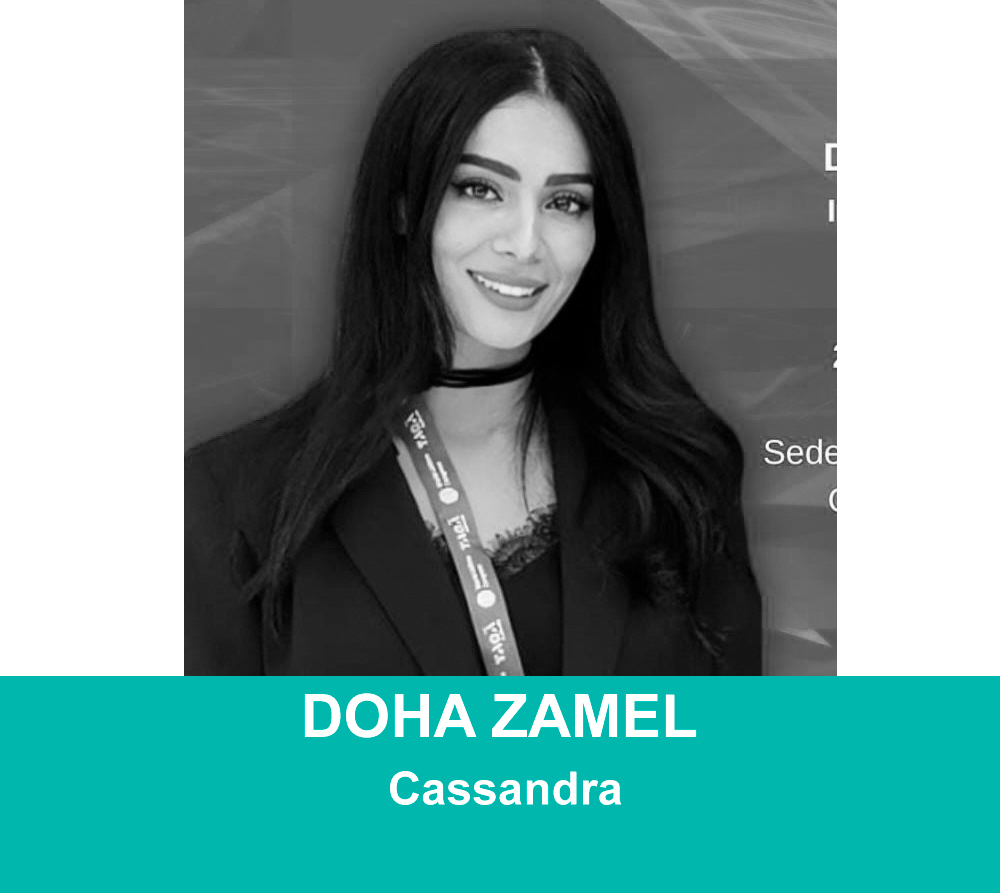
DOHA ZAMEL
Hydraulic Engineer Tunisia and Spain, Cassandra
Doha Zamel is a seasoned water governance and climate resilience expert with over a decade of experience supporting regional cooperation and sustainable water resource management across the Mediterranean and MENA regions. She worked for the Mediterranean (UfM) and the European Commission’s Joint Research Centre (JRC) and the UNEP Regional Activity Center, Plan Bleu.
Her work bridges science, policy, and stakeholder engagement, with a focus on integrated water resources management (IWRM), gender mainstreaming, and the Water-Energy-Food-Ecosystems (WEFE) Nexus. She is the co-editor of The Gateway to the Future of the Mediterranean, a flagship multilingual publication on the WEFE Nexus, and served as lead expert in organizing the Gender and WEFE Nexus Mediterranean Series, a regional initiative culminating in high-level recommendations presented at COP16 UNCCD.
Doha previously served as Country Water Assistant for Tunisia at the Regional Environmental Center for Central and Eastern Europe (REC), where she contributed to dialogue facilitation, climate adaptation initiatives, and national stakeholder coordination under the WATER POrT project. Earlier in her career, she was involved in participatory basin management and stakeholder engagement through the EU-funded BeWater project at the National Institute for Research in Rural Engineering and Forestry (INRGREF) in Tunis. Nos she serves a one of the coordinators of the Cassandra Conference, an initiative led by EURECAT.
She holds a Hydraulic Engineering degree from the National Agronomic Institute of Tunis, and has pursued advanced training in project management, water reuse governance, and flood risk assessment. Fluent in Arabic, French, and English, with working knowledge of Spanish and Italian, Doha brings a unique ability to navigate multicultural environments and translate complex water challenges into inclusive and actionable strategies.

BRANDON OKOTH
Co-Founder & Managing Director, The Watoto Program
Brandon Okoth was born in April 2000 in Kibera, Nairobi, and raised by his single mother, alongside his elderly grandmother. The three of them shared a single room home in the heart of the slum. Life was fragile and uncertain. There were days when food was not guaranteed, and survival often depended on whether his mother could earn enough that day to provide a meal. From a young age, Brandon experienced firsthand the harsh realities of poverty. There were times he went without food, was sent home from school because fees could not be paid, and carried the emotional weight of growing up in overcrowded and insecure conditions.
Even as a child, Brandon was deeply aware of the struggles around him. At just eight years old, he began volunteering with Harambee Arts, an expressive arts organization in Kibera that created a safe space for children to express themselves freely. This was during the aftermath of Kenya’s post election violence, which had deeply affected Kibera. Tribal divisions led to the loss of many lives and belongings, leaving the community traumatized. Harambee Arts used art as a tool for healing, peace, and reconciliation.
Every Saturday, the organization’s founder Gloria would arrive with large tins of paint and brushes. Together, the children painted their dreams and messages of peace on whitewashed walls throughout Kibera. Through this experience, Brandon was first exposed to the power of service, creativity, and community led change. It planted a lasting belief in him that even small actions can restore dignity, hope, and opportunity to children with very little.
As he grew older, Brandon became increasingly conscious of the challenges faced by children in Kibera, not only poverty but also trauma caused by domestic violence, neglect, and abuse. These were struggles he understood not from a distance, but from lived experience. He had walked the same paths, sat in the same classrooms, and shared the same fears and dreams as the children around him.
At just fourteen years old, Brandon turned his vision into action by founding Brandon’s Academy, a program designed to support children from first through eighth grade and into high school. Serving as coordinator and advisor, Brandon became a vital bridge between schools, parents, and sponsors. His lived experience of hardship and resilience fuelled his commitment to guide children toward a better life. Through education, he saw a path not only to break the cycle of poverty but also to restore hope, confidence, and purpose in young hearts.
In 2022, at the age of 22, Brandon co-founded The Watoto Program together with his friend Magnus. The idea was simple but deeply powerful. Brandon opened up the very room that had once been his childhood home, the single space he had shared with his mother and grandmother, and transformed it into a child friendly library and learning space. What had once been a symbol of hardship became a place of safety, learning, and belonging.
Children from across the community were welcomed into this space. They came to read, do homework, ask questions, and most importantly to feel seen, loved, and valued. The Watoto Program was never just about books or academics. It was about healing, trust, and giving children a sense that their lives mattered and that their futures could be different.
Over time, Brandon’s role evolved from beneficiary to volunteer, from volunteer to founder, and eventually to a sponsor himself. Having once relied on support, he became part of the system that now supports others. Today, he remains actively involved in developing and expanding projects under The Watoto Program, driven by a deep commitment to give back to the community that shaped him.
Brandon’s journey from a single room home in Kibera to creating spaces of opportunity for the next generation is rooted in empathy, resilience, and lived experience. His story is not only about overcoming adversity, but about transforming it into purpose, and ensuring that children growing up in circumstances like his are given the chance to dream, grow, and thrive.

GHADEER ARAFEH
Palestine Local Climate Forum
Ghadeer A. Arafeh is an environmental and climate resilience consultant with over 15 years of professional experience in environmental governance, water and sanitation (WASH), disaster risk reduction, and climate adaptation in fragile and conflict-affected contexts.
Her work focuses on the intersection between environmental degradation, climate change, and socio-political instability, with extensive field and policy experience in Palestine, particularly in Gaza and the West Bank. Ghadeer has worked with international organizations, NGOs, and public institutions on environmental impact assessments, climate resilience strategies, and community-based adaptation initiatives.
Through her work, she advocates for recognising environmental destruction as a critical yet often overlooked consequence of conflict, and for integrating conflict-affected regions into global climate action and resilience frameworks.